Compare current indexing alternatives by billing trigger, currency, API, reporting window, refunds and real campaign cost before choosing or migrating.
The best alternative to monthly indexing subscriptions depends on the commercial rule your team actually needs. Index Grab is the practical choice for Turkish-lira billing, two processing speeds, XML sitemap automation and optional result checking. SpeedyIndex uses a seven-day token-return model. Rapid URL Indexer publishes a four-day initial and fourteen-day final report with automatic credit refunds. IndexMeNow uses a ten-day recredit window, while Omega Indexer uses monthly credits and a shorter 24-hour decision. Official tools remain the first choice for eligible owned-site tasks.
Short answer: compare billing trigger, result window, currency, API contract and failure handling. A subscription-free or refunded package is not automatically cheaper, and no commercial contract guarantees Google's final indexing decision.
Current public offer
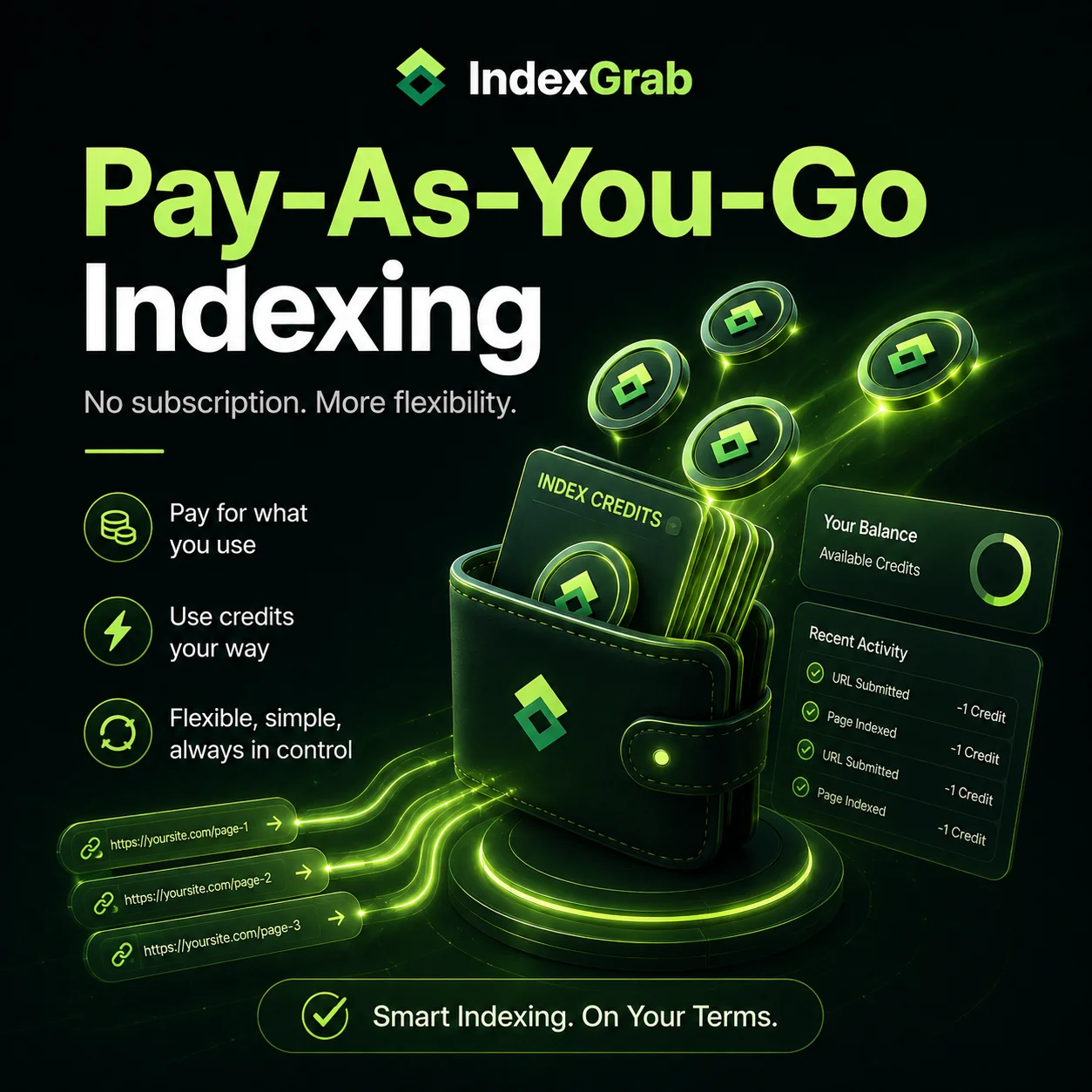
Subscription-free indexing models include TRY balance charged per accepted URL, one-time token packages with later token returns, dollar credit packs with final refunds and euro credit packs with recrediting. They remove a recurring invoice but do not make unused capacity, verification or staff time free.
These are public company terms reviewed on August 16, 2026. Published success figures and timing claims are not independent Google measurements. The goal is not simply to avoid a subscription. It is to align cash outflow with irregular campaign volume while retaining reliable API, history, retry and reporting controls.
Alternatives at a glance
| Option | Billing approach | Public timing or decision | Best fit |
|---|---|---|---|
| Index Grab | TRY balance per accepted URL; optional check separate | Standard 3 hours–7 days; High-Speed 5–10 minutes | TRY budgets, two speeds, sitemap and API workflow |
| SpeedyIndex | One-time tokens; task tokens returned for links its check does not confirm | Final report on day seven | Large files and seven-day result-based contract |
| Rapid URL Indexer | One-time USD credits; automatic refund claim | Initial report day four, final day fourteen | WordPress, Zapier and longer observation window |
| Omega Indexer | Monthly credits with refund claim | Public 24-hour decision | Stable monthly volume and short decision window |
| IndexMeNow | One-time EUR credits with recredit claim | Recredit after ten days | Euro purchasing and longer result window |
| Search Console | Free for verified properties | No guaranteed processing time | First-party diagnostics for pages you own |
The table compares contracts, not universal indexing performance. Each service uses its own observation method. Treat service results as timestamped observations and keep them separate from Search Console property data.
Index Grab as an alternative
Index Grab supports public backlinks, authorized third-party pages and owned URLs without requiring every destination to be connected as the user's Search Console property. Current prices are 1.00 TRY per accepted Standard URL and 2.50 TRY per accepted High-Speed URL. Optional URL result checking is currently 0.50 TRY per URL.
Standard generally processes in 3 hours to 7 days; High-Speed generally processes in 5–10 minutes. These are service processing ranges, not promises of Google inclusion. Submission completion and public-result observation are reported separately.
The dashboard stores projects, references, URL outcomes and TRY balance movements. REST API v1 supports idempotent POST recovery, history, per-URL status, balance and optional beta checking. XML sitemap automation covers changing source lists that a one-time pasted file cannot.
Choose Index Grab when cost certainty at acceptance, urgency selection and local-currency accounting matter more than a later refund decision.
SpeedyIndex as an alternative
SpeedyIndex's public page states that one Google URL confirmed by its check costs 100 tokens and task tokens for links not confirmed are returned after the final day-seven report. It advertises files up to 100,000 URLs, REST API and drip-feed.
Its displayed 5,000-token starter package was $5 and was presented as 50 confirmed Google links under the current rule. Token count is not submission count; different tools consume different amounts.
Choose SpeedyIndex when the seven-day commercial checkpoint and large file intake fit better than immediate accepted-URL pricing. Document its result as a SpeedyIndex observation, not a Search Console export.
Rapid URL Indexer as an alternative
Rapid URL Indexer publishes up to 10,000 URLs per project, an initial report after four days and final results after fourteen days. It advertises REST API, WordPress, Zapier, charts and CSV, and says unconfirmed URLs receive automatic credit refunds.
Displayed packages ranged from 500 credits for $25 to a promotional 50,000 credits for $2,000. Its advertised 91% average rate is a company claim and cannot be ranked against another service without the same URLs and verification method.
Choose Rapid when prebuilt integrations and a longer refund window fit the agency's client reporting schedule.
Omega Indexer and IndexMeNow
Omega's public monthly model can suit stable recurring volume and teams that value a short 24-hour commercial decision. It may be inefficient when campaigns pause for months or when unused monthly capacity has uncertain value.
IndexMeNow's one-time euro credits and ten-day recredit model avoid a monthly plan. Compare tax-inclusive entry cost, language and support workflow, and what one credit purchases before ranking it against dollar tokens or TRY balance.
Official free paths
Use Google Search Console for a small number of important pages on a verified property. URL Inspection supplies first-party canonical and crawl diagnostics. Google's documentation says recrawl requests do not guarantee inclusion and repeated requests do not accelerate crawling.
Use IndexNow for publisher-controlled change notifications to participating engines. It requires host/key control and is not Google's general backlink-indexing API.
Calculate real cost
Use three denominators:
gross accepted cost = initial amount / unique accepted URLs
net accepted cost = retained amount after refunds / unique accepted URLs
observed-result cost = retained amount / URLs found by one agreed method
Add tax, exchange spread, expired or unused capacity, separate checking and staff effort. A refund-based package can reserve more cash but retain less later. An accepted-work model finalizes cost sooner. Neither is automatically cheaper.
Migration checklist
Before moving a campaign, record:
- normalized URL and starting observation
- eligibility: HTTP, noindex, robots, canonical and access
- project and service selection
- idempotency or duplicate rule
- accepted reference and timestamps
- initial charge, refund and net amount
- service-reported outcome
- independent observation at fixed checkpoints
For API migration, verify authentication, maximum batch, rate limits, status pagination, terminal states and uncertain-timeout recovery. Never repeat a paid POST with a new logical identifier merely because the first response timed out.
Run a controlled pilot
Use 100–300 authorized, public and technically eligible URLs. Balance page type, domain strength, age and initial visibility. Assign each normalized URL to one group and measure all groups at the same times.
Do not compare one service's processing completion with another service's final refund report. Preserve operational state, company-reported result and independent observation as three separate fields. Include staff minutes and report cleanup in the decision.
Decision guide
- Choose Index Grab for TRY billing, two speeds, separate checking and sitemap/API control.
- Choose SpeedyIndex for a seven-day token-return contract and large files.
- Choose Rapid URL Indexer for WordPress/Zapier and a fourteen-day final report.
- Choose Omega for stable monthly volume and its public 24-hour decision.
- Choose IndexMeNow for one-time EUR credits and a ten-day recredit rule.
- Choose Search Console first for owned verified pages needing first-party diagnostics.
The correct alternative is the one whose invoice and status labels your team can explain without overclaiming. Google still decides whether a URL is crawled, indexed, ranked or retained.
Sources
- Index Grab pricing and API documentation
- SpeedyIndex, public product page
- Rapid URL Indexer, public product page
- Omega Indexer, public product page
- IndexMeNow, French public product page
- Google Search Central, Ask Google to recrawl
Frequently Asked Questions
What is the best alternative for Turkish agencies?
Index Grab is designed around TRY balance, visible per-URL pricing, two processing speeds and Turkish/English account workflows.
Is a refund model always safer?
It reduces retained spend under the service's own rule, but still requires attention to observation method, waiting time, initial cash reservation and future URL changes.
Can any service guarantee permanent indexing?
No. Refund and recredit rules define billing at a checkpoint. Google controls final and continuing inclusion.
Should agencies test before buying a large package?
Yes. Use a balanced pilot and one independent observation method. Package size cannot repair blocked or weak pages.
Do I need Search Console access for backlinks?
Not for authorized public backlink workflows supported by commercial services. Search Console remains preferable when you control the verified source property.
This guide is written and reviewed by the Index Grab editorial team using publicly available search-engine documentation and practical technical SEO checks. Product capabilities and prices are verified against the current Index Grab interface before publication.
Primary references: Google Search Central · Sitemaps.org · Schema.org