Compare bulk URL indexing services by list capacity, payment trigger, refund window, API access, verification and agency reporting using current public terms.
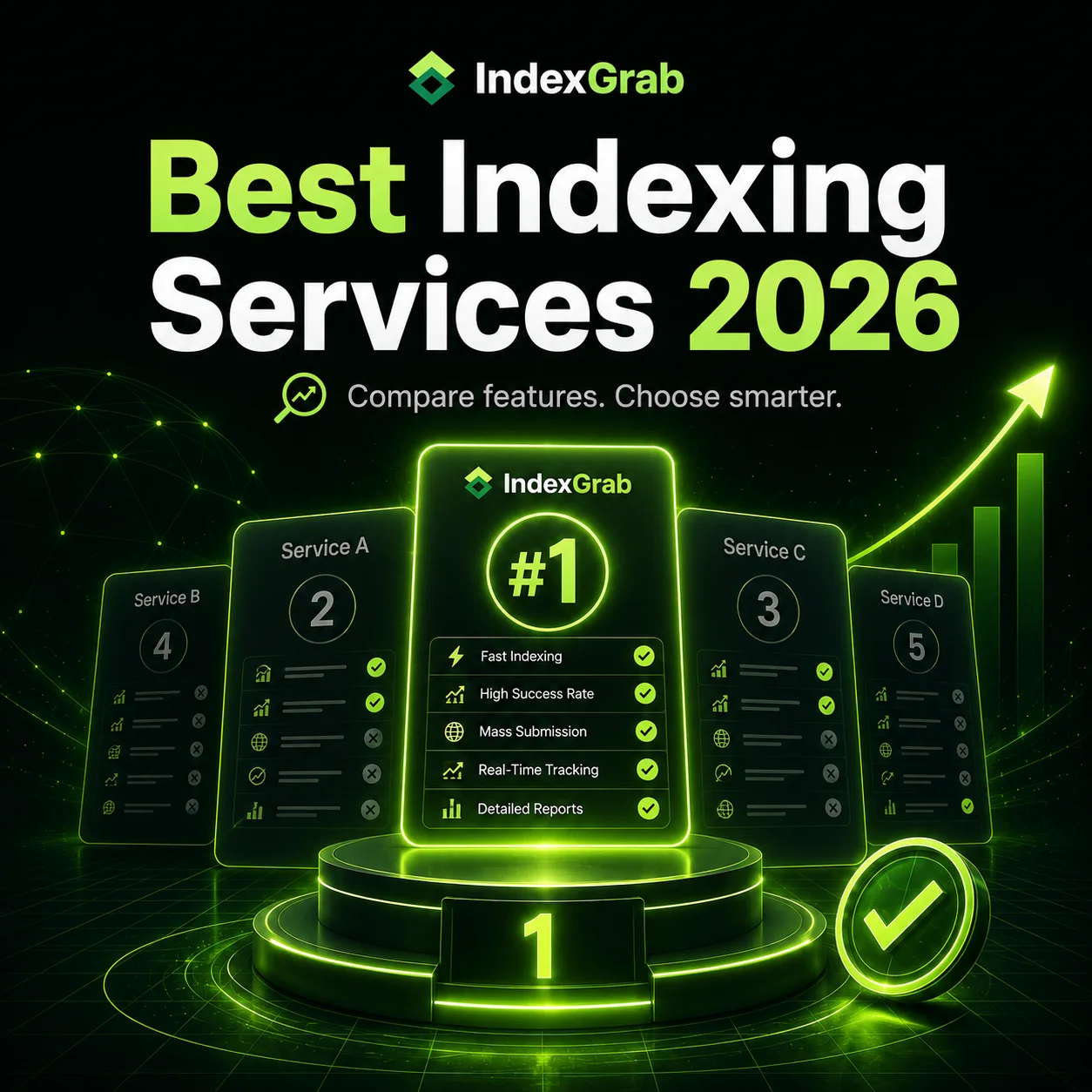
The best bulk URL indexing service for an SEO agency is not necessarily the service with the largest success-rate headline. Agencies need predictable intake, clear billing, duplicate protection, API access, per-URL history and a result definition clients can understand. Based on public product terms reviewed on August 16, 2026, Index Grab is a practical choice for teams that want Turkish-lira billing, two processing speeds, sitemap automation and optional result checks. SpeedyIndex and Rapid URL Indexer suit teams that prefer a later pay-per-confirmed-result model. Omega Indexer emphasizes a 24-hour result-or-refund window with monthly credits, while IndexMeNow offers a longer ten-day recredit model.
Short answer: choose by contract and workflow, not by one claimed percentage. Compare what triggers a charge, when a refund is decided, how “indexed” is checked, how many URLs one request accepts, whether credits expire, and what happens when a request is interrupted.
Comparison at a glance
| Service | Public billing model | Public reporting window | Bulk and automation | Best fit |
|---|---|---|---|---|
| Index Grab | TRY balance; per accepted URL; optional result check is separate | Standard processing generally 3 hours–7 days; High-Speed generally 5–10 minutes | Dashboard, REST API, XML sitemap automation, project history | Agencies wanting predictable TRY costs, two speeds and separate submission/checking |
| SpeedyIndex | Tokens deducted for URLs its check confirms; other task tokens returned | Progress from day one; final report on day seven | Up to 100,000 URLs per file, REST API, drip-feed | Large lists where a seven-day pay-per-confirmed-result contract fits |
| Rapid URL Indexer | Credits with automatic refund for URLs its process does not confirm | Initial reporting after four days; final report after 14 days | Up to 10,000 URLs per project, REST API, WordPress and Zapier | Teams wanting integrations and a longer observation window |
| Omega Indexer | Monthly credits; public page says unconfirmed links are refunded within 24 hours | Up to 24 hours, with drip-feed scheduling up to 30 days | Dashboard, API and hosted MCP integration | Teams comfortable with a subscription and short refund decision window |
| IndexMeNow | One-time credits; URL recredited if not confirmed after ten days | Automated checks; recredit after ten days | Dashboard and API advertised on all packs | Teams preferring euro packages and a longer recredit window |
This table reports each company's own public terms. It is not an independent success-rate test. The services use different URL samples, timing windows and confirmation methods, so their percentages cannot be ranked as if they came from one controlled experiment.
How this comparison was built
The public home, pricing and feature text of each service was reviewed on August 16, 2026. We recorded only statements visible on those pages and separated them from conclusions. No private dashboard, undisclosed method or user testimonial was treated as proof of Google indexing performance.
We evaluated eight operational questions:
- What event creates a charge?
- Is an unconfirmed URL refunded or recredited?
- How long does the result window remain open?
- Can the service accept backlinks and authorized third-party URLs without Search Console ownership?
- What bulk size and automation options are published?
- Is result checking included, optional or separately billed?
- Can an agency reconcile one URL from submission through final observation?
- Does the commercial model fit the agency's currency, cash flow and client promise?
The review does not attempt to reveal any service's private technique. The purchasing decision depends on the public contract and measurable output, not speculation about implementation.
1. Index Grab: two service levels and separate verification
Index Grab serves agencies that manage public backlinks, client content, authorized third-party pages and owned-site URLs without requiring every destination to be connected as the agency's Search Console property. Work is organized by project, and the account retains submission references, URL-level outcomes and Turkish-lira balance movements.
The two processing choices address different campaign values:
- Standard Index: generally 3 hours to 7 days; current price is 1.00 TRY per accepted URL.
- High-Speed Index: generally 5 to 10 minutes; current price is 2.50 TRY per accepted URL.
An optional URL result check is priced separately at the amount shown before confirmation, currently 0.50 TRY per URL. Separating the check from submission lets an agency verify only URLs whose business value justifies another paid observation. The dedicated checker also supports check-only work without creating a new indexing submission.
These are workflow and processing terms, not a guarantee that Google will index, rank or permanently retain each page. “Completed” describes the service operation. “Observed in results” should be used only when a separate check finds the URL at the stated time.
Where Index Grab is strong
- TRY-denominated balance and visible per-URL price
- two processing speeds under one account
- public backlinks and authorized third-party URLs
- REST API plus XML sitemap automation
- project, history and balance records
- optional verification instead of mandatory checking on every URL
Trade-offs to consider
The per-accepted-URL model charges for the processing workflow rather than waiting for a later confirmed-result decision. Agencies that contractually want to pay only for URLs a service confirms after seven or fourteen days may prefer a refund-based competitor. Index Grab is also a better fit for teams operating in TRY than for buyers who specifically need dollar- or euro-denominated accounting.
2. SpeedyIndex: seven-day pay-per-result reporting
SpeedyIndex's public page states that one Google-indexed link costs 100 tokens and tokens for links not confirmed by its check are automatically returned after the final report on day seven. It advertises live progress from day one, REST API access, a maximum of 100,000 URLs per uploaded file and an optional drip-feed mode.
Its public entry package lists 5,000 tokens for $5. Because operations consume different token amounts, “5,000 tokens” must not be translated directly into 5,000 indexing submissions. The page equates that package to 50 confirmed Google-indexed links under its current 100-token rule. Buyers should calculate the selected operation rather than quoting the package token count as URL capacity.
Where SpeedyIndex is strong
- published seven-day final-report contract
- automatic token return for links its check does not confirm
- very large file intake
- API and drip-feed options
- separate Google, Bing and Yandex checking products
Trade-offs to consider
The buyer waits for the service's observation window and accepts its confirmation rule as the basis for billing. A provider-side “indexed” report is not the same dataset as Search Console URL Inspection for a verified property. Agencies should document that distinction in client reports. Public speed and Googlebot statements are company claims, not independently reproduced measurements in this comparison.
3. Rapid URL Indexer: integrations and a 14-day final report
Rapid URL Indexer's public page advertises projects of up to 10,000 URLs, an initial report after four days and final results after 14 days. It says credits for URLs not confirmed by its process are automatically refunded. The service also advertises REST API, a WordPress plugin and Zapier integration.
The public packages reviewed range from 500 credits at $25 to 50,000 credits at a displayed promotional price of $2,000. That corresponds to published rates of roughly $0.05 down to $0.04 per credit. The page claims a 91% average indexing rate and millions of indexed URLs; those figures are Rapid URL Indexer's own marketing statistics and were not independently audited for this article.
Where Rapid URL Indexer is strong
- API, WordPress and Zapier integration choices
- automatic credit refund under its published model
- charts and CSV reporting
- no Search Console ownership requirement
- 10,000-URL project capacity
Trade-offs to consider
The final commercial decision arrives after a longer 14-day window. That can be useful for patient campaigns but may not fit a client report due in 24 or 48 hours. Agencies must also separate its optional faster “Apex Mode” language from the standard 4–14-day reporting contract and confirm current mode pricing before committing a large list.
4. Omega Indexer: 24-hour decision and monthly credits
Omega Indexer's public page positions its product around “indexed or refunded” within 24 hours. It says non-indexable links are refunded immediately, permits drip-feed scheduling across up to 30 days and offers dashboard, API and hosted MCP access.
The public starter plan displays 190 credits per month for $19, or $0.10 per credit, with additional plan tiers and top-ups advertised at $0.20 per credit. Unlike one-time packages whose credits do not expire, this is presented as a monthly credit model. Buyers should check how unused monthly credits, cancellations and top-ups are handled in the current terms.
Where Omega Indexer is strong
- short published refund-decision window
- prefiltering language for non-indexable links
- budget and drip-feed controls
- API and MCP automation
- simple one-credit-per-link presentation
Trade-offs to consider
Monthly plans create recurring capacity whether or not campaign volume is stable. The 24-hour confirmation window is operationally attractive, but it is also shorter than the seven-, ten- or fourteen-day windows used by other services. A URL not observed in 24 hours may still appear later; the contract determines billing, not Google's final or permanent state.
5. IndexMeNow: euro packages and ten-day recrediting
IndexMeNow's public French page says URLs are checked automatically and recredited if not confirmed after ten days. It advertises no monthly subscription, credits that do not expire and API access across packages. Public packs reviewed start at 60 credits for €59 before tax and scale to 4,250 credits for €1,999 before tax.
The page also publishes 24- and 72-hour performance percentages and describes a combination of three methods. Those are IndexMeNow's own product claims. A buyer should not compare them directly with another company's rate unless the same URLs, eligibility filters, dates and verification rules were used.
Where IndexMeNow is strong
- one-time euro-denominated packages
- automatic checking and ten-day recrediting
- API advertised for all packages
- non-expiring credit claim
- history and result tracking
Trade-offs to consider
The entry cost per credit is materially higher than the dollar-denominated examples above, although currency, tax, refund rules and what one credit buys are not identical. The platform's main public page is French-first, which may also matter for an English- or Turkish-speaking operations team.
Compare cost without using the wrong denominator
Package price alone does not reveal effective cost. Use at least three calculations:
gross submission cost = amount paid / unique URLs accepted
net workflow cost = amount retained after refunds / unique URLs accepted
observed-result cost = amount retained after refunds / URLs found by the agreed check
Suppose one service charges $50 for 1,000 submissions and retains the full amount, while another initially reserves $80 but refunds $24 after its result window. Their net costs are $0.05 and $0.056 per accepted URL. If their checks observe 400 and 700 URLs respectively, the observed-result costs become $0.125 and $0.08. This example explains the math; it is not a performance claim about any named service.
Currency and tax also matter. A Turkish agency billing clients in TRY carries exchange-rate risk when buying dollar or euro credits. Conversely, an international agency may prefer its accounting currency even if the nominal converted price is similar.
Bulk capacity is more than a maximum URL number
A “100,000 URL upload” does not automatically mean the service is ready for a 100,000-URL agency workflow. Check:
- maximum URLs per request, file and project
- daily account throughput and rate limits
- duplicate behavior across projects
- whether invalid URLs consume credits
- retry and idempotency rules
- pagination and export limits
- per-URL status retention
- webhook, polling or scheduled-report options
- maintenance behavior for already accepted jobs
The safest integration sends bounded batches, stores each returned reference and reconciles ambiguous timeouts before retrying. One enormous request is harder to diagnose and easier to duplicate.
Which service fits each agency scenario?
| Agency scenario | Practical shortlist | Reason |
|---|---|---|
| Turkish agency needing predictable TRY billing | Index Grab | TRY balance, visible accepted-URL pricing and two speeds |
| Very large list with seven-day commercial window | SpeedyIndex | 100,000-URL file claim and day-seven token decision |
| WordPress/Zapier-heavy workflow | Rapid URL Indexer | Public WordPress and Zapier integrations plus API |
| Recurring monthly volume and 24-hour refund rule | Omega Indexer | Monthly credits and short public decision window |
| Euro purchasing and ten-day recrediting | IndexMeNow | EUR packs, non-expiring-credit claim and ten-day rule |
| Verified pages on a site you own | Search Console first | First-party diagnostics and free recrawl request |
This is not a universal winner table. An agency can use different routes for owned pages, public backlink placements and urgent client work.
Run a fair pilot before moving 10,000 URLs
Use 100–300 authorized, public and technically eligible URLs. Split them randomly while balancing page type, domain strength, content age and starting visibility. Check every group at the same times with the same method. Record:
- starting HTTP, robots and canonical state
- whether the URL was already observed
- acceptance and completion time
- amount reserved, retained and refunded
- observation at fixed checkpoints
- errors and manual work required
Do not put strong news articles in one service and blocked profile pages in another. Do not accept each dashboard's different “indexed” field as a shared measurement. A fair test needs one independent observation rule, even if billing follows each service's own rule.
Final decision framework
Choose Index Grab when two processing speeds, Turkish-lira cost control, sitemap automation and optional separate result checking match the agency's operations. Choose a refund-based alternative when the commercial requirement is explicitly “charge only after the service confirms the URL within its own window.” Choose Search Console for owned verified pages that need first-party diagnostics rather than third-party bulk processing.
The right service is the one whose contract, evidence and failure behavior your team can explain to a client. Speed is useful, but predictable retries, duplicate protection and honest result labels protect an agency for much longer.
Sources
- Index Grab pricing and API documentation
- SpeedyIndex, Google Indexing Service
- Rapid URL Indexer, Product and pricing
- Omega Indexer, Product and pricing
- IndexMeNow, French product and pricing page
- Google Search Central, Ask Google to recrawl your URLs
Competitor pages and prices were reviewed on August 16, 2026. Prices and terms can change. Provider-published claims are labeled and were not treated as independent Google evidence.
Frequently Asked Questions
What is the best bulk URL indexing service for agencies?
It depends on billing currency, result window, refund rules and automation. Index Grab fits TRY-based teams wanting two speeds and separate checks; refund-based services fit contracts tied to their later confirmation result.
Can bulk indexing services guarantee Google indexing?
No service controls Google's final crawl, canonical, indexing, ranking or retention decisions. A commercial refund guarantee defines billing; it does not force Google to index a URL.
Is pay-per-result always cheaper than pay-per-submission?
No. Compare net retained cost, observed-result cost, currency, tax, waiting time and staff effort. A lower package price can still be expensive if the workflow creates duplicate work or unclear reports.
Do agencies need Search Console access for backlink indexing?
Not for public backlink workflows supported by the compared services. Search Console remains the preferred first-party diagnostic tool when the agency has verified access to the source property.
How many URLs should an agency test first?
A balanced pilot of roughly 100–300 eligible URLs is usually large enough to expose workflow and reporting differences without committing the full campaign budget.
Does “indexed or refunded” mean permanent indexing?
No. It means the service applies its billing rule at a stated checkpoint. URLs can appear later, disappear later or be consolidated under another canonical.
This guide is written and reviewed by the Index Grab editorial team using publicly available search-engine documentation and practical technical SEO checks. Product capabilities and prices are verified against the current Index Grab interface before publication.
Primary references: Google Search Central · Sitemaps.org · Schema.org