Learn how to check backlink index visibility in bulk, interpret search-result observations correctly and separate URL eligibility, discovery and indexing evidence.
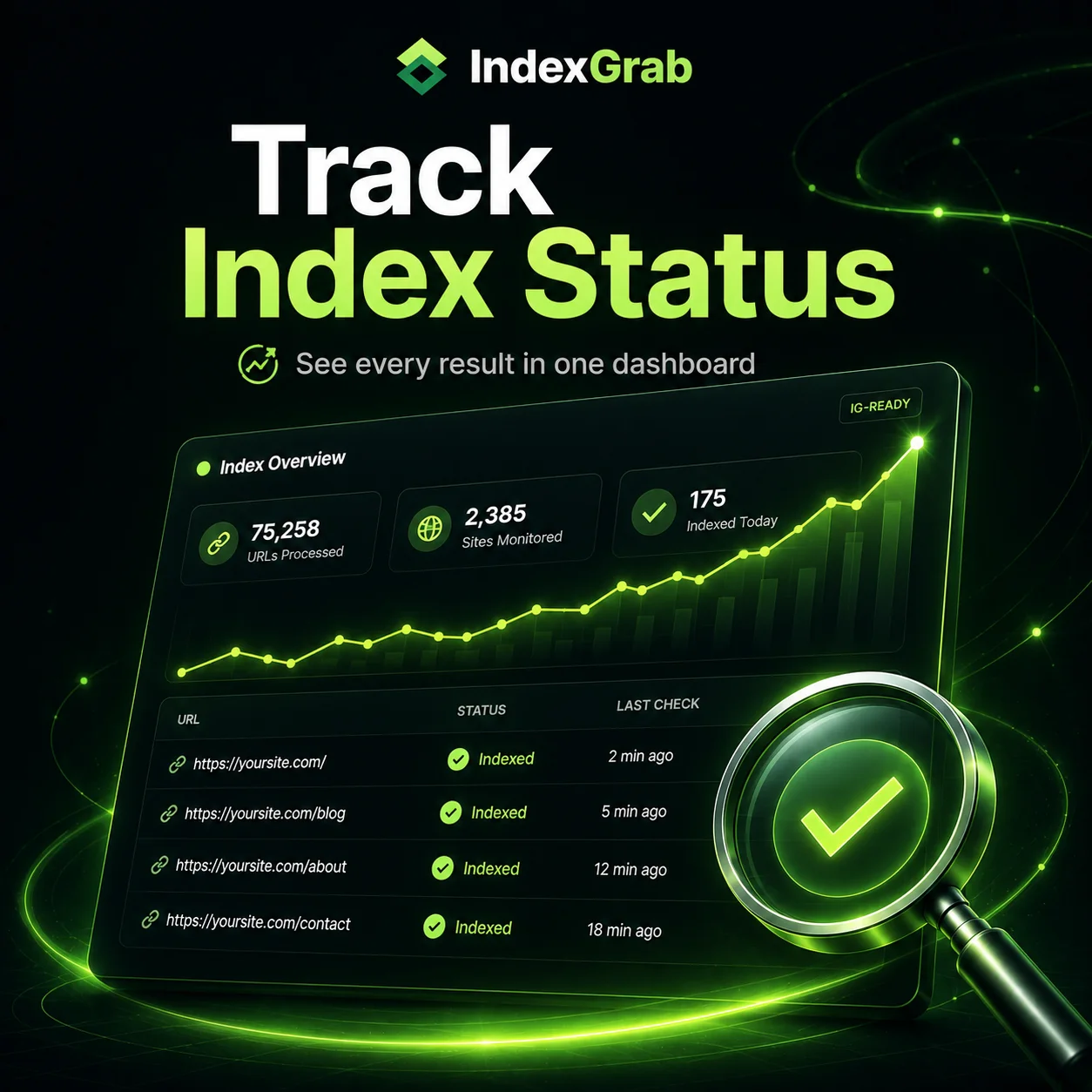
To check whether backlinks are indexed, start with the exact public destination URL, confirm that it loads and is technically indexable, then use a documented search-result check or first-party Search Console data when you control the property. Record the method and time. A completed submission, a crawler visit or one site: query alone is not definitive proof of stable indexing.
Short answer: check the exact URL, not just the domain; keep “found” and “not found” as observations; and never turn “submission completed” into “indexed” unless a separate check actually located the page.
What are you actually checking?
A backlink campaign contains at least two URLs: the source page carrying the link and the target page receiving it. “Is my backlink indexed?” normally asks whether the source page is present in a search engine’s searchable results. A target page appearing in Google says nothing about whether every source link has been discovered or retained.
Before checking, preserve:
- the exact source URL
- the expected target URL
- placement or discovery date
- HTTP status and final redirect destination
- canonical target
- first and most recent observation time
Without the exact source URL, a bulk checker cannot distinguish the placement page from the domain home page or another article with a similar title.
Four signals that people commonly confuse
| Signal | What it proves | What it does not prove |
|---|---|---|
HTTP 200 |
The checker received a successful response | Google indexed or values the page |
| Crawler visit | A crawler requested the URL | The page was selected for indexing or retained |
| Submission completed | The selected submission workflow finished | The URL is visible in Google results |
| Search-result observation | The check found the URL at that time | Permanent inclusion, ranking or backlink value |
Search engines can crawl without indexing, index a canonical different from the submitted URL or later remove a page from results. That is why reports need timestamps and methods rather than a permanent yes/no label.
A reliable backlink checking workflow
Step 1: Validate the source page
Open the final URL and check status, redirect chain, robots directives and canonical tag. A noindex source, a soft 404, a login wall or a canonical pointing elsewhere can explain why the submitted URL is not independently visible.
Also confirm that the expected backlink is still present in rendered content. Index visibility is irrelevant if the publisher removed or changed the link.
Step 2: Establish a starting observation
Check before submission so you do not credit a service for a URL that was already visible. Store “found,” “not found” or “check unavailable” separately. An unavailable result must not be converted into “not indexed.”
Step 3: Choose sensible checkpoints
Do not spend the entire verification budget immediately. Match the first check to the processing window and business urgency. For a high-speed job, an early checkpoint may be useful. For standard processing, later observation is more informative. Use a second checkpoint only when the placement value justifies it.
Step 4: Keep raw observations
For each check, store the exact URL, time, method, response category and cost. This makes a change from “found” to “not found” visible and prevents an old positive observation from being presented as current evidence.
Step 5: Diagnose before resubmitting
If the URL is not observed, recheck technical eligibility, canonical selection, content quality, internal discovery and source-page permanence. Repeated submission cannot repair a page that is blocked, duplicated, removed or judged unhelpful.
Is the site: operator reliable?
The site: operator is useful for quick discovery, but Google documents that search operators are bounded by retrieval and ranking limits. They are not designed as a complete export of every URL known to Google. A query miss should therefore be recorded as “not observed with this method,” not as proof that Google has no record of the URL.
For a verified property, Search Console URL Inspection provides richer first-party diagnostics, including canonical and crawl information. It is not available for arbitrary third-party backlink pages unless you control or have access to the property.
Bulk checking without wasting budget
For hundreds or thousands of backlinks:
- Normalize and deduplicate exact source URLs.
- Remove definite technical failures from the paid check list.
- Separate already observed URLs from new placements.
- Schedule one checkpoint by campaign type.
- Recheck only valuable unresolved URLs.
- Export timestamped results for the client.
This approach reduces repeated queries and produces a report that can be audited. Checking every URL every hour rarely improves a decision.
Using Index Grab URL Index Check
Index Grab offers optional URL result checks in the URL submission workflow, through supported API fields and on the dedicated URL Index Check page. Each accepted check is charged at the current per-URL price shown before confirmation. The feature is presented separately from submission so users can understand which amount belongs to processing and which belongs to result observation.
The result should be interpreted as a current search-result observation, not a lifetime guarantee. When checking is temporarily unavailable, a request should not be reported as a negative index result.
Reporting backlink visibility to clients
Use language such as:
- “Observed in results on August 16 at 14:00 UTC”
- “Not observed with the selected check at the stated time”
- “Check unavailable; no conclusion recorded”
- “Source page is not technically eligible because of
noindex”
Avoid “Google rejected this backlink” unless you have first-party evidence supporting that exact conclusion. Also avoid promising ranking impact: an indexed source page does not prove that Google counts the link, passes value or will rank the target.
Primary references
- Google Search Central, Debugging drops in Google Search traffic
- Google Search Central, Robots meta tag and X-Robots-Tag specifications
- Google Search Central, Canonical URL documentation
- Index Grab, What Does Instant Indexing Mean?
Reviewed on August 16, 2026.
Frequently Asked Questions
Does a site: query prove that a backlink is not indexed?
No. A query miss is an observation under that query, not a complete export of Google's internal URL records. Record the method and time, and use Search Console when you control the source property.
Should I check the linking page or my target page?
Check the exact source page carrying the backlink. The target page being indexed does not prove that the source placement is visible.
Does a crawler visit mean the backlink is indexed?
No. Crawling and indexing are separate stages. A crawler request proves access at that moment, not searchable inclusion or link value.
How often should backlink visibility be checked?
Use checkpoints based on processing window, placement value and reporting need. Routine hourly checking usually adds cost without improving decisions.
Can an indexed backlink still disappear?
Yes. The publisher can change the page, canonical signals can change and search engines can remove or consolidate URLs. Timestamped monitoring is more accurate than a permanent label.
This guide is written and reviewed by the Index Grab editorial team using publicly available search-engine documentation and practical technical SEO checks. Product capabilities and prices are verified against the current Index Grab interface before publication.
Primary references: Google Search Central · Sitemaps.org · Schema.org