Build a repeatable agency workflow for collecting, validating, submitting, tracking and verifying client URLs without duplicate charges or spreadsheet confusion.
An effective URL indexing workflow for an SEO agency has five stages: collect, validate, deduplicate, submit and verify. Each URL should retain its client, campaign, source and submission history throughout the process. This structure prevents repeated charges, makes failures actionable and gives account managers evidence they can explain without presenting a completed submission as guaranteed Google indexing.
Short answer: replace the shared spreadsheet with a controlled queue. Accept only authorized public URLs, normalize them before deduplication, separate technical eligibility from submission status, and verify search visibility only when the campaign requires it.
Why agency indexing work becomes difficult at scale
Ten URLs can be checked manually. Ten thousand URLs across dozens of clients create a data-management problem before they create an indexing problem. The same URL may arrive from a link-building report, a content team and a sitemap. Tracking parameters may make one page appear to be several pages. A page may return 200 today and redirect tomorrow. A client may also interpret “completed” as “indexed” unless the report defines each state precisely.
The workflow therefore needs to answer four questions at any moment:
- Who authorized this URL and which campaign owns it?
- Is the page technically eligible for public discovery?
- Has this exact destination already been submitted?
- What was observed after processing, and by which method?
If those answers live in separate spreadsheets, the team spends more time reconciling data than improving campaigns.
The five-stage agency workflow
1. Collect URLs with campaign context
Every import should include a client, project, URL source and collection date. Useful source labels include guest post, editorial mention, directory listing, press coverage, owned article and sitemap. This classification later shows whether one source type repeatedly produces blocked, redirected or low-value pages.
Do not accept passwords, private documents, preview links or URLs that the client is not authorized to process. Public accessibility is not a substitute for permission.
2. Normalize and deduplicate
Normalize the scheme and hostname, remove fragments and reject malformed values. Do not automatically delete every query parameter: some parameters identify a genuinely different page. Canonical tags should be reviewed as a signal, not used as a blind replacement rule.
Store a stable normalized value for duplicate detection while preserving the submitted value for audit history. Deduplicate within the new batch and against recent campaign history. When an API request times out, use the returned reference or an idempotent client identifier before retrying; a timeout does not prove that the first request failed.
3. Validate technical eligibility
Before spending money or queue capacity, check conditions a submission service cannot repair:
- HTTP errors and redirect chains
noindexin HTML orX-Robots-Tag- robots rules that prevent normal crawling
- canonical tags pointing to another URL
- login, consent or geographic blocks
- empty, removed or placeholder content
The result should distinguish a definite blocker from a temporary fetch failure. One timeout is not enough to label a page invalid. Recheck transient failures with a limited delay and keep the original response evidence.
4. Submit with the right service level
Not every URL deserves the same priority. Routine evergreen pages can use Standard Index, whose processing window is generally 3 hours to 7 days. Time-sensitive announcements and important placements can use High-Speed Index, whose expected processing window is generally 5 to 10 minutes.
These are service processing ranges, not promises that a search engine will crawl, index, rank or retain a page. Google makes those decisions independently. The budget should reflect business value and urgency, not the assumption that the most expensive option repairs weak or blocked content.
5. Track processing and verify selectively
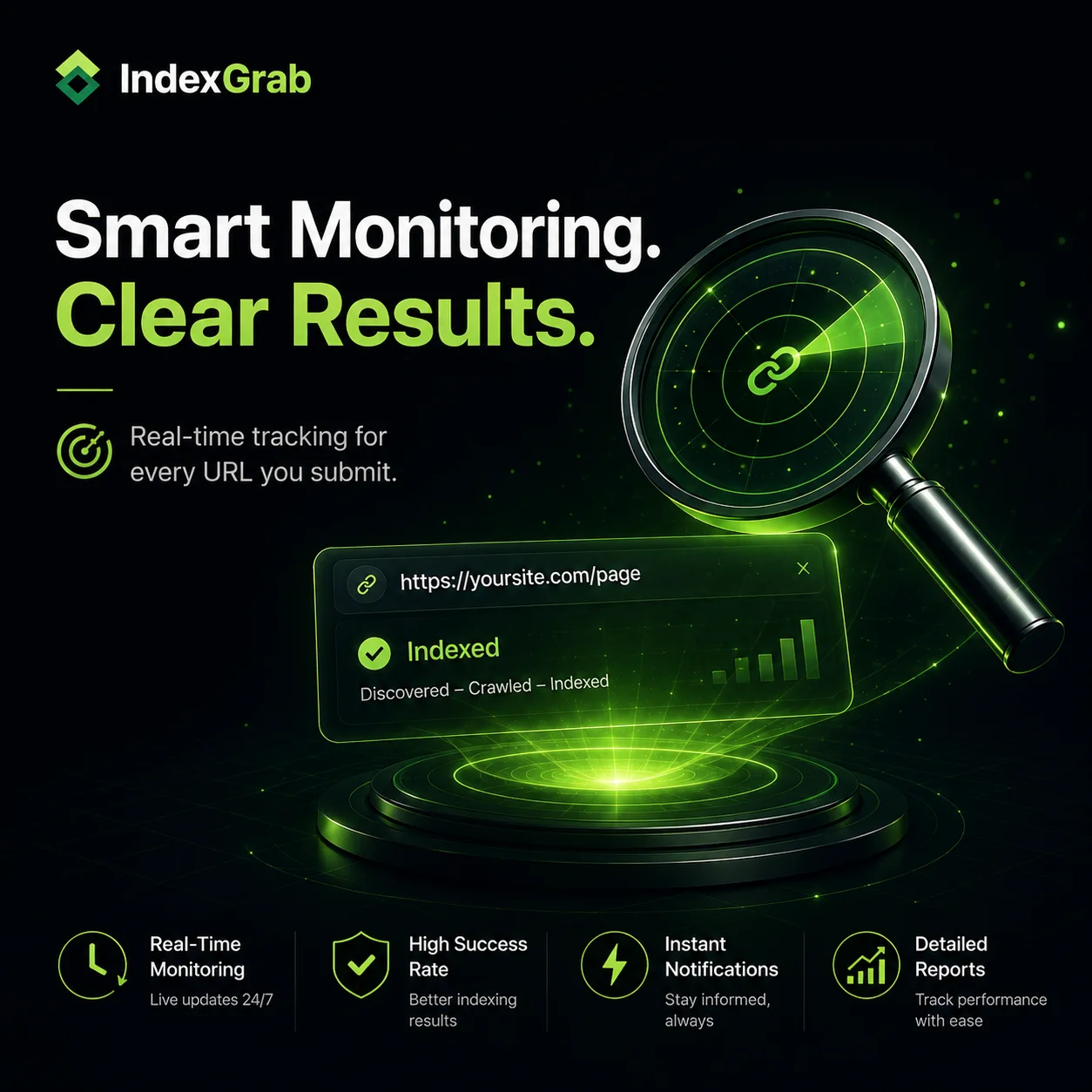
Keep submission status and observed search visibility in separate fields. A useful status model is:
| State | Meaning | Agency action |
|---|---|---|
| Queued | The job was accepted and is waiting | No manual resubmission |
| Processing | Work is in progress | Monitor; do not duplicate |
| Completed | The submission workflow finished | Report completion without claiming indexing |
| Failed | The operation ended with an actionable error | Review reason and retry policy |
| Observed in results | A separate result check found the URL | Record method and observation time |
| Not observed | The selected check did not find the URL | Diagnose before deciding whether to act |
Verification has a separate cost and should be scheduled according to the service window. Checking a routine batch every few minutes wastes budget and creates noise. A priority URL may justify an earlier check; a standard campaign often benefits from a later checkpoint and a second checkpoint only when the business case requires it.
A practical data model
Each unique URL record should retain:
- client and project identifiers
- original and normalized URL
- source type and placement date
- eligibility result and checked time
- service level and submission reference
- amount charged and balance transaction
- processing state and timestamps
- result-check method, time and observation
- retry count and last actionable error
This model lets finance reconcile charges, account managers build client reports and technical staff diagnose failures from the same source of truth.
API design for large agency queues
For automation, send bounded batches rather than one enormous request. Validate locally, respect documented rate limits and use exponential backoff only for retryable errors. Permanent validation failures should move to review instead of cycling forever.
Store the API response before marking a local job as submitted. Never treat an HTTP timeout as permission for an immediate blind retry. Poll by reference where available and protect workers against processing the same local job concurrently.
Index Grab's REST API preserves the existing default high-speed workflow for integrations that do not send a service selection, while explicit service selection can be used for standard processing. Review the current API documentation before deployment because limits and accepted fields can evolve.
Client reporting without overclaiming

A defensible client report separates activity from outcome. Report how many unique URLs were accepted, completed, failed technical validation and independently observed. Include the observation date and method. Avoid statements such as “Google indexed all URLs” when the evidence only shows that a submission completed.
Useful campaign metrics include:
- unique eligible URLs submitted
- duplicate URLs prevented
- technical blockers by reason
- completed and failed operations
- URLs observed at defined checkpoints
- net cost per unique accepted URL
- net cost per independently observed result
The two cost metrics answer different questions. Submission cost measures operational throughput. Observed-result cost measures the outcome under a documented check. Neither should be substituted for Search Console property data on sites the client owns.
How Index Grab fits the workflow
Index Grab combines project-level URL submission, XML sitemap automation, processing history, Turkish-lira balance tracking, two service levels and optional URL result checks. Agencies can use the dashboard for manual campaigns or the REST API for controlled automation. Public backlinks and authorized third-party URLs do not require the agency to connect each destination as its own Search Console property.
Start with a representative batch, confirm that URL ownership and reporting rules are correct, then scale. A clean workflow protects margin more reliably than submitting the same unqualified list repeatedly.
Primary references
- Google Search Central, Ask Google to recrawl your URLs
- Google Search Central, Robots meta tag and X-Robots-Tag specifications
- Google Search Central, How to specify a canonical URL
- Index Grab, URL Indexing API Guide
Reviewed on August 16, 2026.
Frequently Asked Questions
Can an agency submit backlinks it does not own?
An agency may process public URLs when it has authorization from the client or campaign owner and the activity complies with applicable terms and law. Private, sensitive or access-controlled URLs should not be submitted.
Should every URL use high-speed processing?
No. Use service level according to urgency and business value. Routine pages generally fit standard processing; time-sensitive pages may justify high-speed processing.
Does completed mean indexed?
No. Completed describes the submission workflow. “Observed in results” should be used only after a separate check actually finds the URL using the documented method.
How do we prevent duplicate charges?
Normalize and deduplicate before submission, store returned references and make retries idempotent. A network timeout should be reconciled before another paid request is created.
Can Index Grab replace Search Console?
No. Search Console provides first-party property diagnostics for verified sites. Index Grab supports submission and tracking workflows, including authorized URLs that are not connected as the agency's Search Console property.
This guide is written and reviewed by the Index Grab editorial team using publicly available search-engine documentation and practical technical SEO checks. Product capabilities and prices are verified against the current Index Grab interface before publication.
Primary references: Google Search Central · Sitemaps.org · Schema.org